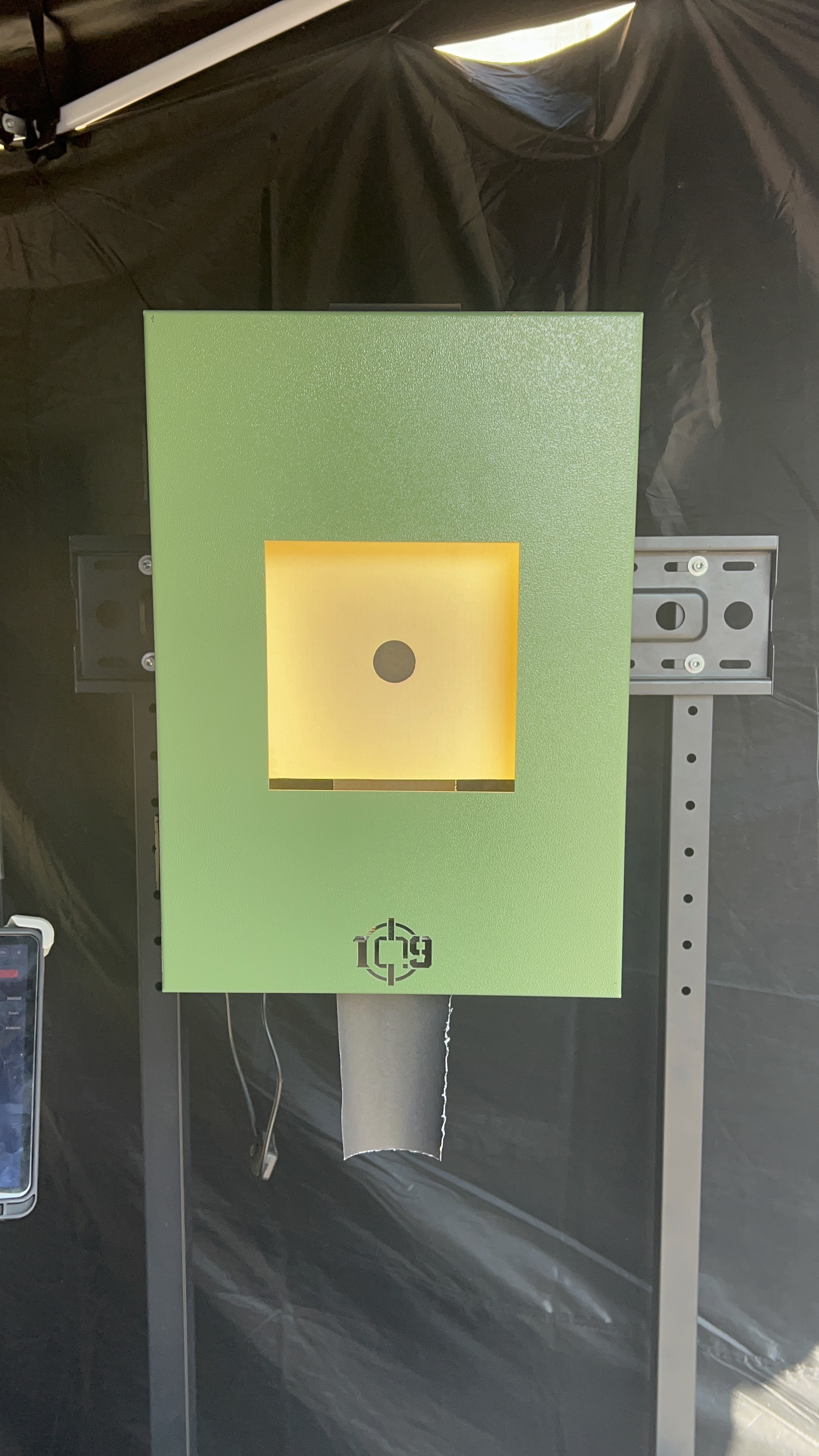
How Electronic Scoring Targets Work: Acoustic, Optical & Hybrid Technologies Explained
If you've walked into a modern shooting range in the last decade, chances are you've seen electronic scoring targets replacing the paper targets that shooters manually checked after every string. But how do these systems actually detect where a pellet hits, score it to a tenth of a ring, and display the result on a screen within milliseconds?
In this guide we break down the three main technologies used in electronic scoring targets today — acoustic, optical and hybrid — so you can understand what's inside the machine, how each approach works, and what the real-world differences mean for your training and competition.
What is an electronic scoring target?
An electronic scoring target is a device that automatically detects the impact point of a projectile on a target, calculates a score based on its position relative to the centre, and displays the result digitally — all without anyone walking downrange.
In competitive shooting governed by ISSF (International Shooting Sport Federation) standards, the target face is divided into concentric scoring rings. A shot landing dead centre scores 10.9 (inner ten), while shots further out score progressively lower — 10.0, 9.9, 9.8, and so on down to 0. Electronic targets calculate this position with sub-millimetre precision and display the decimal score instantly.
The key question isn't whether electronic targets are more convenient than paper — they obviously are. The real question is: how does the machine know exactly where the pellet hit?
Acoustic technology: listening for the impact
How it works
Acoustic electronic targets detect shots using sound. When a pellet passes through a paper target and strikes the sensor area, it creates a sound wave. Four acoustic sensors — one in each corner of the target — pick up this wave at slightly different times.
The core principle is called acoustic trilateration. Since sound travels at a known speed (roughly 343 metres per second in air), the system calculates the exact impact point by measuring the time difference between when each sensor detects the sound. The sensor closest to the impact hears it first; the furthest hears it last. From those four time measurements, the system triangulates the precise X-Y coordinates of the hit.
The maths behind it
Think of it this way: if the top-left sensor detects the sound 0.0001 seconds before the bottom-right sensor, the impact was closer to the top-left. By combining the time differences from all four sensors, the microprocessor calculates the exact position to within a fraction of a millimetre.
This is the same principle used in earthquake detection (seismology) and GPS satellite positioning — proven physics applied to a 10-metre shooting range.
Accuracy
Modern acoustic systems achieve sub-0.1mm accuracy — meaning the system resolves the pellet position to within a tenth of a millimetre. For context, a human hair is about 0.07mm thick. These systems are scoring to that level of precision.
The key requirement: clean paper
Since acoustic targets detect the sound of a pellet breaking through paper, there's one critical requirement: the pellet must hit clean, unbroken paper. If a second shot passes through an existing hole, there's no paper to break and no sound to detect. This is why acoustic systems advance the paper roll between shots.
Paper advancement settings typically range from 10 steps (minimal, for loose groups) to 50 steps (maximum, for tight groups). Most shooters find 30 steps works well for regular training.
Tip: If shots stop registering, paper advancement is the first thing to check — not the sensors. See our Troubleshooting Guide.
Who uses acoustic technology
Acoustic technology is used by several electronic target manufacturers worldwide. It's the dominant approach for 10m air rifle and air pistol systems thanks to its reliability, precision and cost-effectiveness. PerfectShots uses this approach across its 10m, 25m and 50m target systems.
Optical / imaging technology: seeing the impact
How it works
Optical electronic targets use cameras or light sensors to detect and score shots. The most common approach uses a backlit target face with a high-speed camera positioned behind it. When a pellet passes through, it creates a hole in the target face, and the camera detects the break in the light pattern to calculate position.
Some systems use infrared LED arrays and photodiode grids instead of cameras. The pellet breaks infrared beams as it passes through, and the system calculates position based on which beams were interrupted.
Accuracy
Optical systems can achieve accuracy comparable to acoustic systems. The precision depends heavily on camera resolution and the quality of the backlighting setup.
Advantages
- Can potentially detect shots through existing holes (with camera-based analysis)
- No dependency on paper advancement for detection
- Works with various calibres without modification
Challenges
- Camera systems add cost and complexity
- Lighting conditions must be carefully controlled
- Higher power consumption
- More components that can fail
- Generally more expensive to manufacture and maintain
Hybrid approaches
Some manufacturers combine acoustic and optical elements. A system might use acoustic sensors for primary detection with an optical confirmation layer for redundancy, or primarily optical detection with acoustic timestamps for improved accuracy.
Hybrid systems aim for the best of both worlds, but come with increased complexity and cost.
How scoring actually works
Regardless of detection technology, the scoring calculation follows the same process:
- Impact detection — the system detects the pellet's impact point
- Coordinate calculation — X-Y coordinates are determined relative to target centre
- Distance calculation — the distance from centre to impact is computed
- Ring mapping — that distance is mapped to the ISSF scoring rings
- Decimal score — the score is calculated to one decimal place (e.g. 10.3, 9.7, 8.1)
- Display — score and shot position are sent to the connected device
All of this happens in milliseconds. On modern systems the shot appears on your tablet almost the instant the pellet lands — response times under 0.5 milliseconds are standard.
Connectivity: WiFi vs wired
WiFi systems
Modern electronic targets increasingly use WiFi connectivity. The target unit runs an embedded wireless controller that creates a local WiFi network. Your tablet, phone or laptop connects directly — no internet required.
Advantages:
- No cables to run from the target to the firing line
- Connect multiple devices simultaneously
- Range of 50+ metres, more than enough for any standard range
- Easy setup — connect to the network and open the app
Wired systems (RS-485 / Ethernet)
Older and some commercial-grade systems use wired connections, typically RS-485 serial cables or Ethernet, running from each target position back to a central computer.
Advantages: no wireless interference, consistent latency, suitable for large installations with 20+ lanes.
Disadvantages: cable installation cost and complexity, less flexible positioning, a single point of failure if cables are damaged, and dedicated computer infrastructure.
For most training setups and smaller ranges, WiFi has become the preferred choice for its simplicity and flexibility.
What to look for when choosing a system
1. Accuracy and scoring standard
Look for sub-millimetre accuracy with ISSF-based decimal scoring. Ask the manufacturer for their accuracy specification — anything resolving to 0.1mm or finer is competitive with the best systems available.
2. App and platform support
Training value comes not just from the hardware, but from the software that analyses your shots. Look for apps on your preferred platform — Android, iOS, Windows or Mac — offering practice mode, match simulation and shot analysis at minimum.
3. Training features
Basic systems only score shots. Advanced systems actively improve your performance. Features like Follow Through Mode, Rhythm Training and structured challenge programmes turn a scoring device into a training partner — see PS Academy.
4. Power and electrical safety
Power delivery matters more than most buyers expect. Improper earthing or reversed Live/Neutral wiring is a leading cause of faults — missing shots, wrong positions, connection drops. Look for a system that ships with a socket tester so you can verify the outlet before connecting anything.
5. Connectivity
WiFi is the modern standard for ranges up to 50 metres. For a large facility with 20+ lanes, check whether the system supports multi-lane management through a single controller or requires individual connections.
6. Total cost of ownership
Purchase price is just the start. Consider paper roll costs, maintenance, and software update availability. Some systems charge for software updates; others include them free.
The future of electronic targets
Electronic target technology continues to evolve. Current trends include:
- Integrated mental training — systems that track not just where you shoot but how you train mentally. PerfectMind pioneers focus-level tracking alongside shot scoring.
- Performance development training — moving beyond scoring to structured skill development like PS Academy, which builds capability systematically on real ISSF competition data.
- Cloud analytics — aggregating performance across sessions for long-term progress tracking and coach review.
- Cross-platform ecosystems — train on any device, access data anywhere, share results with your coach remotely.
Conclusion
Electronic scoring targets — acoustic, optical or hybrid — have fundamentally changed how shooters train. Technology once reserved for Olympic venues is now accessible for personal setups, club ranges and academies.
The core principle is straightforward: detect the impact, calculate the position, display the score. The differences between systems come down to how they detect the impact (acoustic vs optical), how they connect (WiFi vs wired), and what they do with the data (basic scoring vs advanced training).
For shooters looking to bring electronic targets into their training, the PerfectShots product range covers 10m, 25m and 50m disciplines with acoustic trilateration, WiFi connectivity, and a full training ecosystem through the PerfectShots app and PS Academy.
Questions about which system fits your range? Get in touch — we'll help you work it out.